
The Sustainability Myth: Why the Grindadráp Is Not What Faroese Authorities Claim
As of July 24, 2025, at least 520 long-finned pilot whales have been killed in the Faroe Islands across five grindadráp hunts. Among the dead: pregnant females, unborn calves, and young whales who hadn’t yet reached maturity. This year’s hunts don’t just raise ethical concerns — they challenge the assertion that the grindadráp is sustainable.

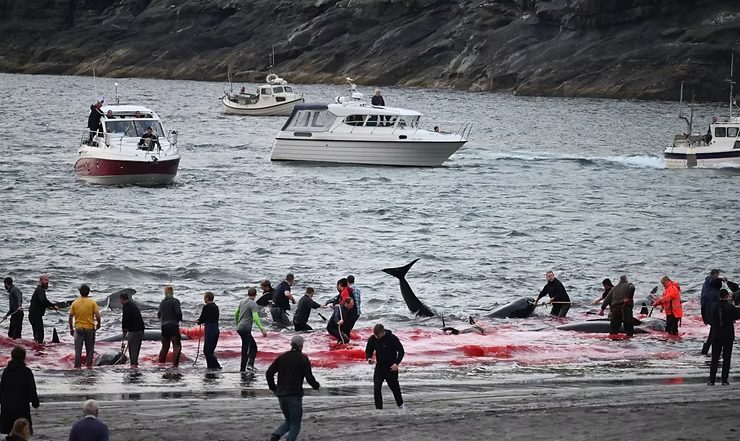
Pilot whales killed on July 20th in Tjørnuvík.
Killing the Future of the Species
Tjørnuvík is one of the Faroe Islands’ most iconic tourist destinations. It hadn’t hosted a grindadráp since 2017. That changed on July 20th when more than 26 boats drove a pod of 117 pilot whales ashore — in full view of tourists, locals, and Sea Shepherd volunteers, who managed to reach the site before police closed off the road. After the slaughter, Sea Shepherd confirmed:
- 15 whales were pregnant, raising the actual death toll to 132 when including unborn calves
- At least 7 were juveniles
This single hunt illustrates a larger truth: the grindadráp is not ecologically sound. When a killing method indiscriminately targets pregnant females and young whales who have never reproduced, it prevents the pilot whale population from growing — the very foundation of sustainability.
“The Faroese government insists the grindadráp is sustainable,” said Valentina Crast, Campaign Director for Sea Shepherd. “But when you destroy mothers and babies en masse, you’re not ‘harvesting a resource’ — you’re cutting off its future.”
Documented Toll of 2025 So Far
- 520 total pilot whales killed
- At least 44 pregnant females killed along with their unborn calves
- Unborn calves discarded, not counted in kill totals
- Confirmed juvenile deaths in multiple hunts
- No transparency or accountability from Faroese authorities
In Leynar alone, 25 pregnant females were killed in a single day. Add 4 more from Bøur, and 15 from Tjørnuvík, and the count climbs to at least 44 unborn calves. The actual number is likely higher, given the lack of transparency. The principle of sustainability — as defined by NAMMCO — requires that resources are used at rates that do not exceed nature’s ability to replace them. This killing does not meet that definition.
Long-finned pilot whales reproduce slowly, giving birth to a single calf every 3–5 years. They live in tight-knit family pods. Every pregnant female killed represents not just one, but two lives lost — a devastating blow to an already slow-recovering population.
Tradition Should Not Bypass Scrutiny
The grindadráp is considered a proud cultural tradition by many Faroese people. But tradition doesn’t grant immunity from scrutiny — especially when the practice involves wiping out entire whale pods, including future generations, with motorboats and jetskis.
The way cetaceans are treated in the Faroe Islands must evolve in the face of ecological science, ethical reflection, and growing international condemnation.
It’s Time for the Faroese to Speak Up
If sustainability means preserving a resource for future generations, the grindadráp fails by every measure. It destroys the whales of tomorrow before they’re even born.
As we continue to urge European leaders to challenge the false sustainability narrative, we call on Faroese citizens — especially those silently opposed — to speak up and demand an honest conversation about the true cost of this tradition.

A dead pilot whale killed on July 20th in Tjørnuvík.
Read more and get involved at stopthegrind.org
