
Upper Gulf of California, Mexico
Inside Sea Shepherd’s 12th year fighting to save the Vaquita in Mexico’s Upper Gulf of California
For the last three years, I have had the honor of commanding the M/V Seahorse, 130 feet of steel carrying long-range radar, sonar, thermal drones, satellite communications and a fast boat. Eighteen people are aboard with one mission: defend the Vaquita porpoise and the waters it depends on.
This Saturday, as International Save the Vaquita Day is marked around the world, we will be putting the Seahorse through sea trials in Mazatlán after her refit. In the Upper Gulf, a smaller Sea Shepherd team has remained on watch, flying drone missions over the Zero Tolerance Area in the Vaquita Refuge. Next week, we head north to relieve them. The ship beneath my feet is the latest chapter in a mission that has kept changing because the threat demanded it.
That threat is the illegal gillnet. Many of the deadliest nets were set for totoaba, an endangered fish hunted for its valuable swim bladder. That trade turns a fishing problem into a cartel-driven wildlife crime. The net we haul over the rail is often the last link in a much larger criminal economy.
Twelve Years of Ships
From the Martin Sheen to the Seahorse
The small sailing vessel Martin Sheen entered the Upper Gulf in 2015 on the first Operation Milagro. Those first crews came to find the Vaquita, document what was happening and prove that the species was still here.
By then, the collapse was staggering: about 567 Vaquitas in 1997, 245 in 2008 and just 59 in 2015. In less than two decades, the population had fallen by nearly 90 percent. Those estimates reflect decades of work by scientists including Dr. Barbara Taylor, Armando Jaramillo, and Dr. Lorenzo Rojas-Bracho, who have been central to Vaquita surveys since 1997, and Dr. Gustavo Cárdenas-Hinojosa, who leads CONANP’s acoustic monitoring program today.
By the time I took command of the Seahorse, years of crews had already kept returning to these waters. As the mission grew from observation to removing nets and confronting poachers, Sea Shepherd kept bringing more capable ships with them.
Twelve Years of Ships · Operation Milagro to Vaquita Defense
Farley Mowat joined for Milagro II and Sam Simon during Milagro III. John Paul DeJoria, Sharpie and later White Holly followed, giving crews heavier working platforms for an increasingly demanding operation.
Farley Mowat and Sharpie held the line through violent attacks, gunfire, firebombs and the pandemic. In 2023, the Seahorse arrived after being refitted specifically for this mission.
To me, that succession of ships is a record of persistence. Every time the mission outgrew a ship, tactic or piece of equipment, Sea Shepherd adapted and came back with more capability.
This Saturday is International Save the Vaquita Day, and we have put together an eight-minute look back at how we got from those first patrols to the permanent presence we maintain today.
The Nets
From Pulling Nets to Keeping Them Out
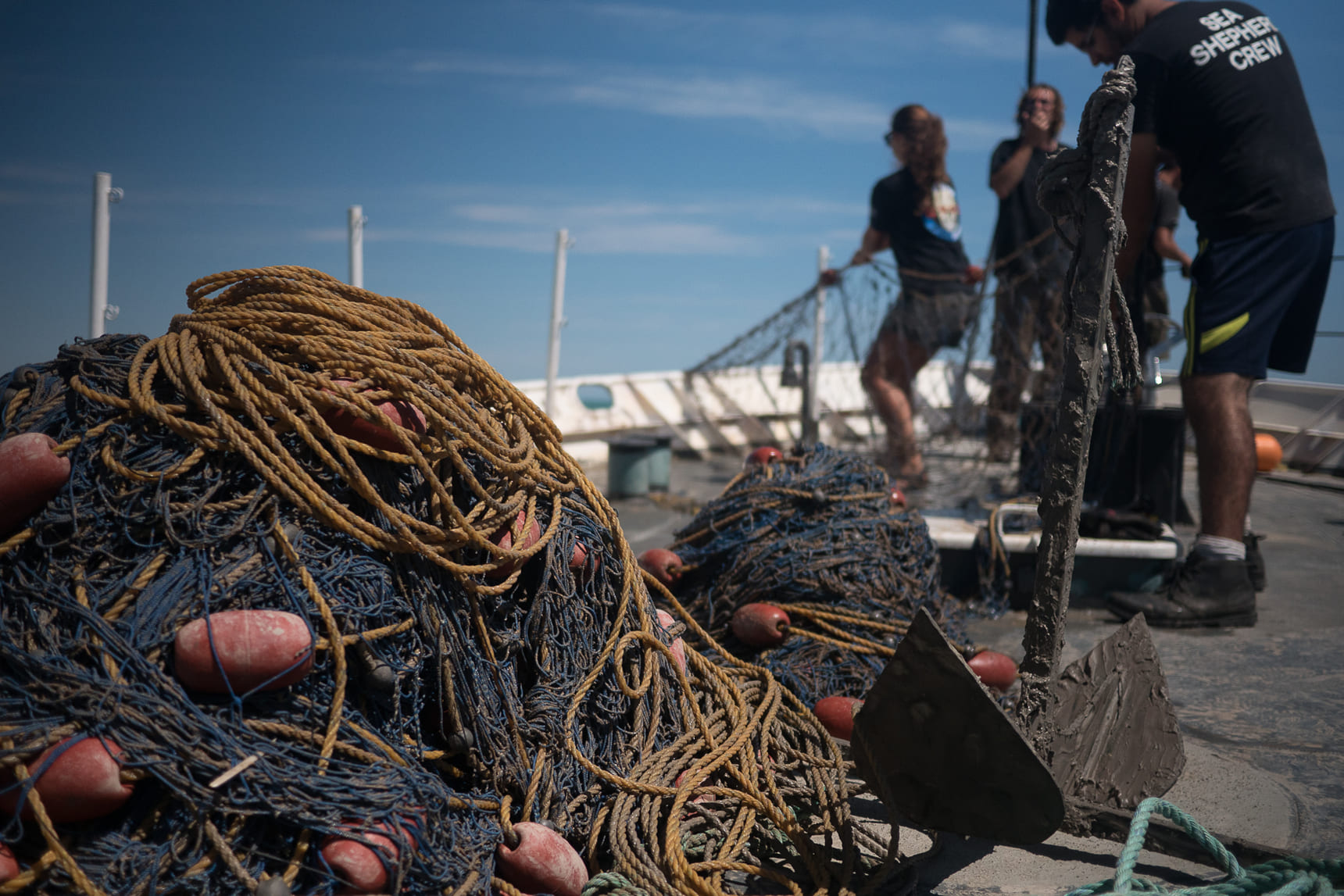
To understand how we got from those early patrols to today’s permanent watch, we have to go back to the end of 2015. That was when Sea Shepherd received authorization to begin removing the illegal gillnets threatening the Vaquita, and the work became brutally physical. Crews used grappling hooks to locate submerged nets they often could not see. When they found one, they hauled until the mesh broke the surface, brought it onto deck and went back for the next.
The Nets and the Response · Upper Gulf of California
Over the course of this campaign, Sea Shepherd crews and our partners have hauled thousands of pieces of illegal fishing gear out of Vaquita habitat, from full gillnets to buoys, sinkers, anchor lines and the hardware that holds them in place.
Vaquitas are the reason this mission began, but those nets kill indiscriminately. Our crews and Mexican partners have freed sea lions, sharks, rays, fish and even a humpback whale from the same gear. Every net removed clears the water for an entire ecosystem.
But the real goal was never to become better at finding nets. It was to stop them from going into the water in the first place.
The Government of Mexico changed the operation zone too. Beginning in 2022, the Mexican Navy placed concrete blocks fitted with steel hooks across the Zero Tolerance Area, later expanding protection into the Extension Area. Today, more than 400 hooked blocks reinforce the protected zone and make it increasingly difficult to fish illegally.
When the Seahorse is on station, we watch vessels move across the ZTA on radar, use sonar to locate gear beneath the surface, fly drones miles from the ship and launch the fast boat when something needs a closer look.
But detection has to lead to enforcement. Sea Shepherd also provided two 27-foot high-speed Seahawk patrol boats to the Mexican Navy for use inside the Vaquita Refuge. Our mechanic team maintains them, while Navy crews operate them for rapid patrols and enforcement. When activity is detected on the open water, those boats give authorities a fast, reliable way to respond. They are a major part of what Sea Shepherd brings to this partnership: not only the ability to see what is happening, but hardware that helps turn surveillance into action.
Working alongside Mexican authorities, that combination of physical barriers, surveillance and enforcement has helped reduce fishing activity inside the ZTA by approximately 95 percent. Gear that once routinely appeared in the protected core has been nearly eliminated.
What Holds the Line
What It Takes to Stay
The approximately 95 percent reduction in illegal fishing activity inside the ZTA did not happen because the threat simply faded away. It happened because people kept showing up.
Mexican Navy crews patrol and intercept boats. Environmental agencies support the science and protection measures. Local partners keep working, our crews keep returning, and supporters give us the resources to keep ships, people and technology in the Upper Gulf long enough to change conditions on the water.
The Seahorse is a reminder of what that commitment costs. A working ship deployed nearly year-round gets punished by salt, heat and thousands of engine hours. Fast boats, drones and electronics need constant attention.
A permanent presence cannot depend on one ship. This week proves it. While the Seahorse finishes sea trials in Mazatlán, a smaller Sea Shepherd team remains in the Upper Gulf, working with local groups and Mexican authorities and flying drone missions over the ZTA. Next week, we will relieve them and take the ship back on station.
Now, in our 12th year in the Upper Gulf, that succession of ships, crews, technology and partnerships has become a permanent watch over the Vaquita’s most critical habitat.
The 2025 Survey
What the Surveys Are Showing
Ultimately, the measure that matters most is whether Vaquitas are still being seen, heard and born in these waters.
For years, scientists warned that extinction could be imminent. Every illegal net remains a serious threat, but the surveys now show something those early numbers could not: Vaquitas are resilient! They are still surviving and reproducing.
For the 2025 monitoring effort, the Seahorse and Bob Barker served as research platforms for an international science team. Experienced observers scanned from six 25 × 100 “Big Eyes” stations while Mexican acoustic teams, led by Dr. Cárdenas-Hinojosa’s CONANP group, listened beneath the surface. Dr. Taylor and Dr. Rojas-Bracho brought decades of Vaquita survey experience to the work, while our crews kept the ships, equipment and logistics running.
Observers most likely saw 7 to 10 distinct Vaquitas in the Zero Tolerance Area and Extension Area, including one and probably two calves. Scientists do not treat that as a total population estimate because Vaquitas move in and out of the study area. The important point is that the catastrophic decline seen years ago is no longer evident within the area being monitored.
Read the full Vaquita survey results
In May 2026, we used the Seahorse as a training platform too. Working with CONANP, Mexican agencies and the San Felipe community, we helped train a new generation of Mexican Vaquita observers in visual detection, photo-identification, environmental DNA and acoustic monitoring. The campaign also recorded three visual sightings and 72 acoustic encounters, reinforcing the importance of waters northwest of the protected core. The goal is to build a predominantly Mexican team capable of carrying this work forward, including a full observation cruise planned for May 2027.
They are still breeding. They are still moving through the only habitat they have ever known. They are still here.
Vaquitas in the Upper Gulf · Photographed 2019 to 2025
International Save the Vaquita Day asks the world to look toward this small corner of Mexico and see what persistence can build when people refuse to walk away.
On October 16, Sea Shepherd will also participate in a gallery exhibition featuring photographs of nets recovered from the Upper Gulf, a record of the threat our crews and partners have spent years removing.
As I write this, the Seahorse is finishing sea trials in Mazatlán. Next week, we point her north to relieve the drone team already holding the watch.
There is still work ahead of us. But the Vaquita is still here, and so are we.


