
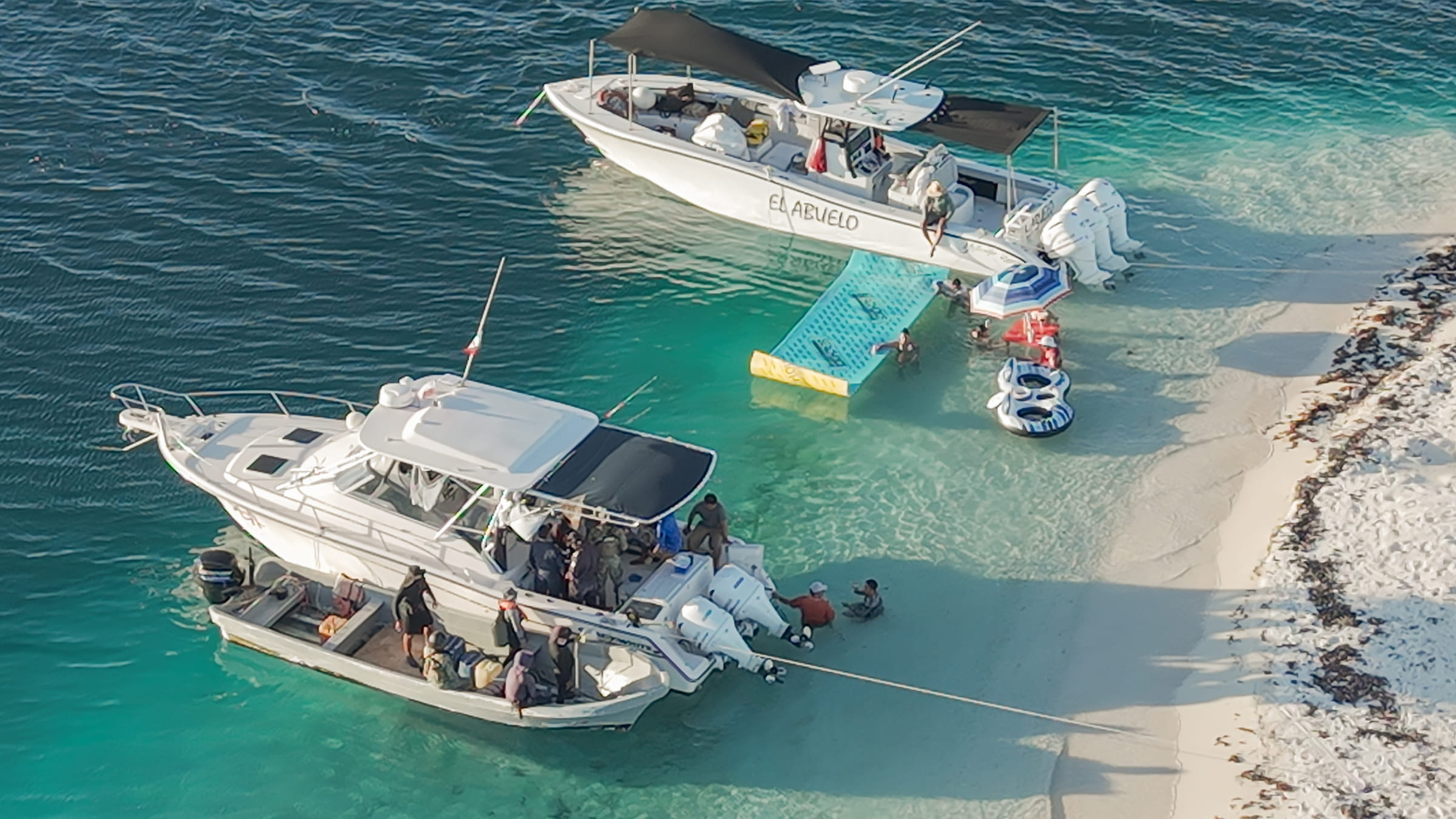
Isla Pájaros, Scorpion Reef, Mexico
On September 26, our drone looked down on the vessels Seamaster and El Abuelo anchored a few meters off the beach at Isla Pájaros, with lines run to the sand and passengers in the water around a floating mat and inner tubes. The island sits inside Arrecife Alacranes National Park, also known as Scorpion Reef or Alacranes Reef. Along with Isla Chica, it is protected as a nesting site for brown boobies and sea turtles, and anchoring there is prohibited.
Profepa, Mexico’s federal environmental enforcement agency, seized both boats that day. It had seized a third, the Gypsea, at the same island the day before. Our crew and drones helped detect the boats and supported the inspections, working on the water with Profepa’s inspectors and Mexican Navy personnel and documenting both days of the operation. We are on these reefs year-round because their spawning grounds sustain marine life across the Gulf of Mexico.
September 25 and 26
Two Days at Isla Pájaros
Profepa ran a monitoring and inspection operation in the park on September 25 and 26 with the support of Sea Shepherd’s crews and vessels Sharkwater and Roger Payne.
The Gypsea, a two-deck power catamaran carrying nine passengers, was seized on the 25th. The Seamaster, with six passengers, and El Abuelo, with five, followed on the 26th.
Inspecting the Gypsea · September 25
All three boats were anchored, and their passengers had gone ashore and were walking the shoreline. Profepa cited the potential harm to green sea turtle habitat. The species is protected under NOM-059-SEMARNAT-2010, Mexico’s official list of species at risk.
Profepa opened a separate administrative case against each vessel and ordered a precautionary seizure as a security measure. The boats were placed in the custody of the people responsible for them while the cases continue.
Arrecife Alacranes National Park
Why Isla Pájaros Is Protected
Isla Pájaros means Bird Island. Brown boobies nest there, and so do sea turtles, which come ashore on its beaches to lay their eggs.
The park’s Management Program allows boats to anchor only in designated areas over bare or sandy bottom with no vegetation, deeper than five meters (about 16 feet), near Isla Desterrada and in certain areas next to Isla Pérez. At Isla Pájaros and Isla Chica, both protected nesting sites, anchoring and overnight stays are prohibited.
Boat traffic and people on the sand disturb sea turtles during nesting and hatching season, which is why the park bars anchoring at these islands. In September our crew helped release turtle hatchlings at Scorpion Reef, and every one of them started in a nest on a beach like this one.
Permits and Zoning
What the Permits Did Not Cover
All three boats had authorization to be inside the protected area, and their passengers wore the required wristbands. What they did at Isla Pájaros was still not permitted.
Inspecting the Seamaster and El Abuelo · September 26
Scorpion Reef sits about 80 miles off the Yucatán coast, and its zoning only works if everyone who brings passengers out follows it. A permit to enter the park is not permission to anchor anywhere in it, and Profepa’s three cases make that clear to every operator working the reef.
Scorpion Reef and Bajos del Norte
Defending Endangered Marine Life in the Gulf of Mexico
A crisis is unfolding across the Gulf of Mexico. A study published this year found that total fisheries production in US waters of the Gulf fell by about 42 percent in the early 1990s after a severe drought, and it warns of deeper losses ahead. With the Gulf already under that strain, illegal fishing is striking the reefs it can least afford to lose: the spawning grounds that sustain marine life across the region.
Scorpion Reef and Bajos del Norte are critical nurseries for grouper, snapper and other species in the southern Gulf. Red grouper catches on the Campeche Bank fell by more than half between 1991 and 2003, and the stock remains depleted. Poachers continue to plunder these breeding populations, and now Sea Shepherd ships are there to stop them.
We will not ignore the lessons from the collapse of other marine ecosystems. The Newfoundland cod collapse in 1992, caused by overfishing, left northern cod at about 1 percent of historic levels. The ongoing loss of wild Pacific salmon along the west coast of North America is another lesson in what happens when action comes too late. These are examples of what could happen in the Gulf of Mexico, and happen soon, if illegal, unreported and unregulated fishing is not halted now.
Sea Shepherd is meeting that threat with a model proven in the Vaquita Refuge. There, our permanent presence, together with Mexican authorities’ patrols and physical barriers, has helped reduce illegal fishing activity inside the Zero Tolerance Area by about 95 percent. Our two ships, the M/V Sharkwater and the M/V Roger Payne, now hold station year-round across more than 6,300 square miles of protected reef. Radar tracks boats moving across the park, and long-range and thermal drones put suspect vessels on record day or night. When poachers move in, our fast boats launch with the Navy.
We work with the Government of Mexico through the Mexican Navy (SEMAR), Profepa, the Protected Areas Commission (CONANP) and the National Fisheries Commission (CONAPESCA). We bring the ships, the crews and the surveillance, and Mexican authorities carry out enforcement. Joint operations on these reefs have seized 720 kilograms of illegally caught fish from a single boat and stopped three poachers working the reef with scuba gear and a dive compressor.
Our crews and the Navy at Scorpion Reef, 2025 and 2026
At Isla Pájaros, our crew and drones helped detect the three boats, supported the inspections and documented both days from the water and the air. Profepa’s inspectors boarded the boats, opened the cases and ordered the seizures, with Navy personnel on the water alongside them. Every photograph in this story was taken by our crew.
Profepa says it will continue surveillance across Arrecife Alacranes and Bajos del Norte. Our ships and crews will be on the water to support that work. Sea Shepherd is acting aggressively today to prevent ecological collapse in the Gulf of Mexico.
Direct Action Crew
Keep the Crew on the Reef
Monthly supporters fund the fuel, the dives and the patrols that keep our crews on station at Scorpion Reef.
